Conferences
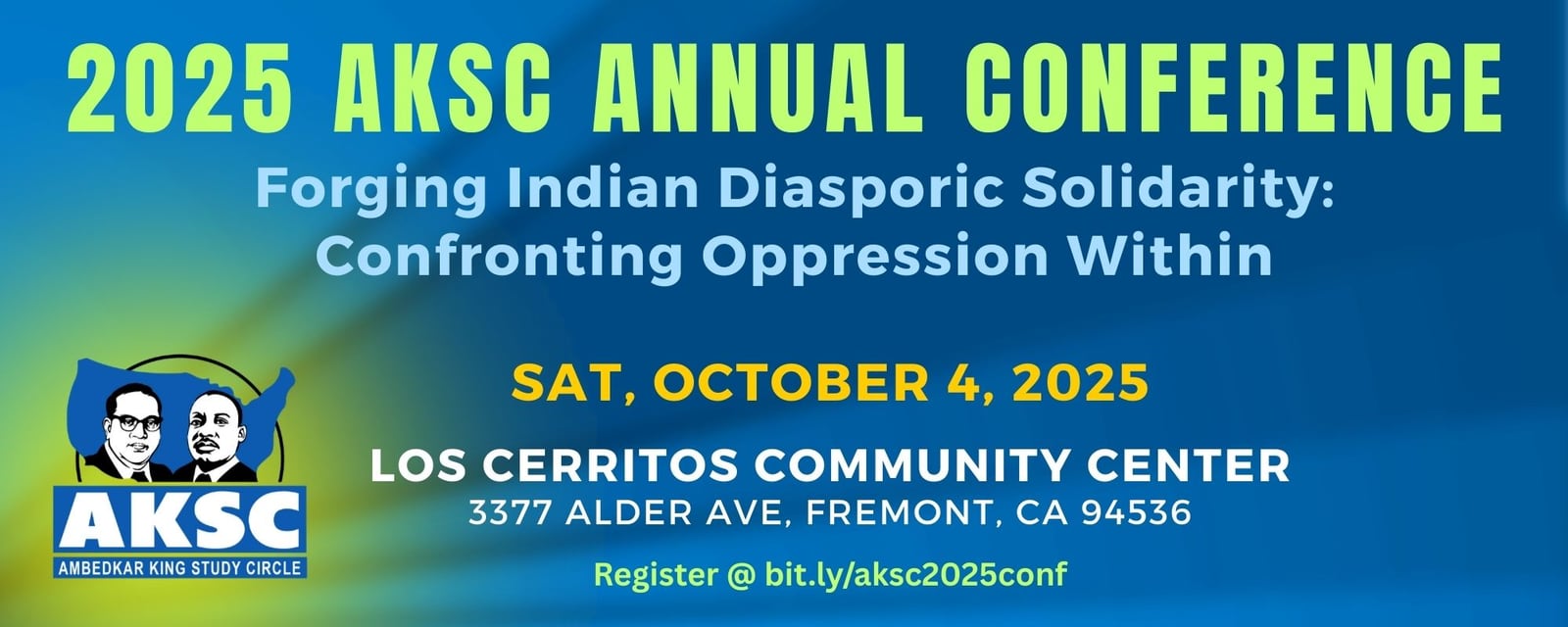
AKSC 6th Annual Conference 2025
The sixth annual conference asks how to create the conditions for anti-caste speech and action in mainstream spaces, and celebrates recent legal victories in anti-caste litigation in the USA.
6th annual
- Date
- October 4, 2025
- Format
- In person
- Theme
- Forging Indian Diasporic Solidarity: Confronting Oppression Within
- Programme
- Full details and speakers
People and movements
Conference speakers
Scholars and organisers working across anti-caste, feminist, housing, human rights, and solidarity movements.
Annapurna WaughrayProfessor of Human Rights Law, Manchester Metropolitan UniversityRead biographyClose biography
Annapurna Waughray is Professor of Human Rights Law at Manchester Metropolitan University, Manchester, UK where she has been a faculty member since 2001. She is a critical legal scholar and activist academic. Her research focuses on human rights, minority rights, discrimination and equalities, in particular caste and the law in India / South Asia, in international human rights law and in the Indian diaspora especially the UK and US.
She holds a BA and MA from Cambridge University where she studied Modern Languages and Social and Political Sciences. She holds an LLM in International and European Law and a PhD in Law from Liverpool University School of Law and Social Justice. She has worked in non-profits in women's rights and health rights and is a qualified lawyer, working as a litigation solicitor before moving into academia. She has written, published, and spoken widely on caste discrimination and the law for over twenty years. She is the co-author of the UK Equality and Human Rights Commission's Research Reports on Caste in Britain (2014), and was a member of the expert advisory group to the United Nations on its Guidance Tool on Caste and Descent-Based Discrimination.
Her recent book Capturing Caste in Law: The Legal Regulation of Caste Discrimination is published by Routledge and is available in paperback and hardback and as an e-book in the UK and India. She is concerned with the uses of law in shaping social change, the potential of the law for those on the receiving end of discrimination, inequality and injustice, and the promotion of legal literacy on caste and caste discrimination and the law among fellow lawyers and non-lawyers including academics, activists and policy actors.
Prachi PatankarWriter and activistRead biographyClose biography
Prachi Patankar is a writer and activist based in New York. Her speaking and organizing is grounded in feminist, anti-caste, and solidarity commitments. Her writing has appeared in outlets including The Guardian, Indian Express, Al Jazeera, Women's Studies Quarterly, and Jacobin. She has been invited to speak at venues such as MoMA PS1, Cornell University, Swarthmore College, and Harvard University. Patankar has been interviewed in media including Democracy Now, Jewish Currents, and National Public Radio.
Patankar was raised in rural India, by a freedom-fighting grandmother and parents who led feminist and working-class movements. For over two decades in New York, she has been involved in work which links the local and the global, police brutality and war, migration and militarization, race and caste, women of color feminism and global gender justice.
Patankar has worked on a diversity of innovative projects to link justice movements between the United States and the Global South. This includes a range of work with CAAAV, Palestine Education Project, and Afghan Women's Mission. She believes in the power of intersectional and international visions and strategies — which resonate across Dalit rights and Black lives, migrant justice and gender justice, to build bottom-up change from the local to the global.
Sandy PerryCommunity organizer and justice advocateRead biographyClose biography
Sandy Perry was raised as a Quaker in Massachusetts and attended Stanford University from 1967-70. He has been a lifelong community organizer and justice advocate, especially after moving to San Jose in 1990. He has been blessed with a 51-year, loving marriage with Andrea Villaseñor Perry, and they have a daughter Christina, son in law Ben, and two grandchildren, Max and Lucia.
In 1991, Sandy joined both the Affordable Housing Network and what is now known as CHAM Deliverance Ministry, and became an active volunteer in both for over thirty years.
Over the years, CHAM helped lead and organize countless rallies, marches, demonstrations, sit-ins, speak-outs, teach-ins and building takeovers to support housing for the unhoused. In 1997, Sandy collaborated with CHAM and First Christian Church to open the church as a shelter for unhoused families. It successfully defied City efforts to shut its doors and then helped create the CHAPP and PROGRESS pilot housing programs.
In 2001, Sandy participated with both CHAM and Affordable Housing Network in successfully advocating for 30% of San Jose's affordable housing funds to be allocated to the extremely low-income families who needed it the most. Affordable Housing Network was instrumental in the campaign to strengthen San Jose's rent control program from 2015-18. In 2017, it helped organize low-income tenants at Sunnyhills Apartments in Milpitas to save their homes, when the owner proposed to opt out of his HUD contract, demolish the apartments, and build million-dollar townhomes instead.
Sandy was a commercial roofer for 20 years and then helped manage the CHAM-First Christian Church homeless shelter from 2000-09. From 2017-20 he was active in efforts by Serve the People San Jose to stop the ill-advised Google expansion into San Jose. In 2019 he helped found the South Bay Community Land Trust and currently serves as vice president of its board.
Dr. Roja Suganthy-SinghAssistant Professor, St. John Fisher UniversityRead biographyClose biography
Dr. Roja Suganthy-Singh was born in Vellore, Tamil Nadu and moved to the US in 1990 pursuing higher education. With a PhD from Rutgers University, New Jersey, she is now Assistant Professor of Sociology, Anthropology, and Gender and Sexuality Studies, at St. John Fisher University, Rochester, NY where she currently resides. Singh widely contributes to building a multicultural and equality in based culture in the Rochester community and University campus through antiracism, anticaste and interfaith leadership work. She brings together leaders from the Rochester community addressing and implementing refugee students' education and initiatives. As a South Asian Dalit feminist scholar, Roja Singh's ongoing activism, research and writings are primarily based among grass roots Dalit women leaders and Dalit communities in rural Tamil Nadu, India. Her scholarship focuses on the intersections of race, class, caste, indigeneity, religion and gender using critical caste lens, post-colonial and transnational feminist frameworks.
Roja is co-founder and co-leader of Dalit Solidarity Forum in the USA, established in 1999, one of the oldest Dalit rights organizations in the USA. She serves on the Executive council and Board of India Civil Watch International. Providing a global humanism outlook, Singh provides lectures and dialogues on a wide range of subjects including Dalit Feminism, earthy humanness, race, gender, caste, religion, class, sexuality, cross cultural interactions, world cultures, indigenous cultural studies, and global gender studies. Working closely with US based South Asian diaspora organizations she advocates for democratic principles along with anti-caste and for-compassion and equality initiatives. She continues to be deeply involved in human rights work in Tamil Nadu, India, and in the US promoting right to education for girls and youth from minority communities. Along with a team, Roja has developed curriculum and workshop materials for college, high-school and other communities for teaching about the dangers of caste practices and to foster a vision for an alternate universe free of caste. She works with young Dalit, Bahujan, and all marginalized scholars, and aspiring writers to edit, enhance and hone their writing for scholarly publishing. Her book, Spotted Goddesses: Dalit Women's agency-narratives on caste and gender violence, is widely recognized and used in universities and activism circles in the US, UK, Australia, and India.
For many, moving abroad promises freedom from the caste system. The reality, however, is that caste follows them, showing up in community gatherings, WhatsApp groups, on college campuses, and in professional settings.
Casteist discussions go unchallenged in workplaces. Oppressed-caste employees and anti-caste allies remain silent out of fear of retaliation. Anti-caste policies are vague. Since caste is disguised as “culture” or treated as a private matter, criticism of caste is framed as an attack on individual freedom. There are no social or legal protections for the caste oppressed or their anti-caste allies.
If anybody dares to voice out, those with caste privilege use power and money to silence the truth. We saw it in the fight over SB 403 in California, where protections for the caste-oppressed were blocked under pressure from wealthy donors. These battles make two things clear: that legal protection is absolutely essential for the caste-oppressed; and that the grave silence around caste oppression needs to be effectively challenged by all.
However, are conditions viable today, for anti-caste speech and action to emerge in mainstream spaces?
Join us in our annual conference to deliberate on how to create the conditions necessary to empower people to break the silence on the topic of caste. To have open and frank discussions on how to create social and legal protections against caste exclusion and oppression. Each one of us has a unique role in forging solidarity by confronting exclusion within. We can make an anti-caste future actually and truly possible, here and everywhere.
Also join us in celebration of legal victories on anti-caste litigations in the USA.
Schedule
| Time | Programme |
|---|---|
| 9:00 AM – 9:40 AM | Registration and meet-and-greet |
| 9:40 AM – 11:00 AM | Session I: Conference introduction and opening; “Caste and Law — An International Perspective: Towards Recognition and Remedy” by Prof. Annapurna Waughray |
| 11:00 AM – 11:10 AM | Stretch |
| 11:10 AM – 12:30 PM | Session II: Poster flash talk; “Political Struggle in Education Spaces” by Prof. Theresa Montaño and Prof. Roja Singh |
| 12:30 PM – 1:15 PM | Lunch and poster session |
| 1:15 PM – 2:35 PM | Session III: Cultural music/song; “21st Century Immigration: Future of American Democracy” by Mr. Sandy Perry and Ms. Prachi Patankar |
| 2:35 PM – 2:40 PM | Team |
| 2:40 PM – 4:15 PM | Session IV: Resolutions and fraternal organization time; “Fractures in the Multiracial Right: What Lies Ahead?” by Prof. Biju Mathew, Ms. Elizabeth Fetterolf, and Mr. Adam S. Iqbal |
| 4:15 PM – 4:30 PM | Break |
| 4:30 PM – 5:15 PM | Session V: Silicon Valley Evening Show with Karthikeyan Mani, Director of Madras Matinee |
| 5:15 PM – 6:15 PM | Session VI: Celebration of legal victories on anti-caste litigations in the USA; open mic and conclusion |
| 6:15 PM – 8:00 PM | Dinner and Kahoot |
The conference featured interactive sessions led by prominent speakers and thought leaders, a focus on anti-caste struggles and strategies in the USA, and opportunities to network with like-minded individuals and organizations.
The registration fee was $40, including lunch and dinner. Attendees aged 20 or younger received a 100% discount, and undergraduate, master’s, and PhD students received a 50% discount.
Poster session call
AKSC invited submissions for a poster session centred around the conference theme: Forging Indian Diasporic Solidarity: Confronting Oppression Within.
The session offered an opportunity to share research, community projects, organizing strategies, or creative interventions that spoke to the shared themes of resisting global oppression, confronting caste in India and abroad, and building solidarities across movements.
Participants were encouraged to present work-in-progress, hypotheses and/or results relating to data-driven or qualitative research, or visual storytelling. Posters could take academic, activist, or artistic forms. AKSC offered to print posters free of charge for participants without access to printing.
Submissions included a poster title and 150–200 word abstract, plus the presenter’s name, affiliation (if any), and contact information. The deadline was 11:59 PM PST on September 28, 2025.
Venue
Los Cerritos Community Center
3377 Alder Avenue
Fremont, CA 94536
Resources
Topics
- Solidarity
- Caste discrimination
- Litigation
- Workplace
Originally published at akscusa.org/aksc2024conf-2.